
Buried in the October 25, 1984 edition of the Miami Herald is an authentic tres leches cake recipe that has quietly outlasted every food trend of the last four decades, and it has a Nicaraguan origin story that most people still do not know. NYU professor of food studies Lourdes Castro stated publicly in the Wall Street Journal that pastel de tres leches belongs to Nicaragua, not Mexico, where it is most commonly celebrated today.
You are about to make the version that found its way into South Florida's most-read newspaper at the height of Miami's Latin American cultural boom, and it is exactly as good as forty years of survival suggests.
The Eggs Are Not the Enemy, I promise
If making tres leches from scratch has ever felt like a lot of work, that feeling almost always comes from one thing: separating the eggs. The technique sounds fussy, but it is the step that makes everything easier, because beaten egg whites are what give this light sponge cake the airy, open crumb it needs to absorb the milk mixture without turning into a soggy block.
Most crowd-pleasing desserts ask you to choose between impressive and easy, but a well-made tres leches cake refuses that trade-off. The ingredient list is short, the techniques are learnable on your first attempt, and the results look like you spent far more time than you did.
The best results come down to two moments of patience: beating your eggs properly and letting the cooled cake soak overnight. Everything else is just baking. You got this!
Back in the 1984 Kitchen
Miami was celebrating Hispanic Heritage Week with flags, music, and more Latin flavor per square mile than almost any other city in America. When the Miami Herald ran this recipe that October, it was not introducing South Florida to tres leches. It was acknowledging what the city's Nicaraguan and Cuban communities already knew: this milk-soaked vanilla sponge cake had earned its place at every table worth gathering around.
In October 1984, The Cosby Show had just launched its first season, Madonna's "Like a Virgin" was weeks away from dominating every radio station in America, and Miami was the most talked-about city in the country, partly for Miami Vice and its pastel blazers, and partly because its Latin American community was one of the most vibrant and culturally influential in the United States.
The Miami Herald was not simply a local newspaper. It was the voice of a city actively absorbing and celebrating the flavors Central American and Caribbean communities brought with them.
By the time this recipe ran in the Herald that October, pastel de tres leches was already a beloved household staple in Nicaraguan and Cuban homes across South Florida. Food historians, including NYU professor Lourdes Castro, have pointed to Nicaragua as the birthplace of tres leches, a country whose economy had grown deeply tied to dairy production by the 1930s. In 1936, President Franklin D. Roosevelt signed a trade agreement with Nicaragua that reduced import duties on dairy products from Wisconsin, which made canned condensed and evaporated milk widely accessible for the first time.
Nestle capitalized on that availability by printing tres leches recipes on their condensed milk cans, spreading the recipe across Latin America for the next several decades. When the Miami Herald published this version in 1984, it was recognizing what the city's Latin community had known for a generation: this milk cake had earned a permanent place at the table.

What Makes This Authentic Tres Leches Cake Recipe So Good
The Vanilla Sponge Cake Base
The foundation of any great tres leches is the sponge, and this one is built specifically for soaking. A light sponge cake made with separated eggs creates a structure that is firm enough to hold together but open enough to absorb the milk mixture all the way down through every layer.
The amount of eggs in this recipe, five large ones, might look like a lot, but each one is doing specific structural work: the yolks add richness and body to the cake batter, while the beaten whites create the airy crumb that makes this a milk cake worth the extra bowl to wash.
The Three-Milk Soak
The milk mixture is where the transformation happens. Three different types of milk combine to create a soak with the perfect balance of sweetness, body, and richness that no single milk can achieve on its own.
The sweetened condensed milk brings thick, caramel-adjacent sweetness and a glossy quality to the soak. The evaporated milk contributes a slightly cooked, full-bodied depth. The whole milk thins the mixture just enough to allow it to travel through all those holes and reach the very bottom of the airy cake. Together, the three kinds of milk create something genuinely greater than the sum of their parts.
The Lightly Sweetened Whipped Cream
The whipped cream topping is not just for looks, though it does look wonderful. It provides a cool, neutral contrast to the sweet, saturated sponge beneath it, and it seals the top of the cake so moisture stays locked in.
Over-sweetening the topping throws off the entire balance of the dessert, which is why powdered sugar works better than granulated here. It dissolves without graininess, incorporates smoothly at high speed, and gives you precise control over sweetness levels. Restraint at this step is what separates a good tres leches from the best tres leches.
Why Separating Eggs Matters
The spongy texture of a tres leches cake is a direct result of folding whipped egg whites into the cake batter, and it is worth understanding why. When beaten to stiff peaks, the egg white mixture introduces thousands of tiny air pockets into the batter. Those air pockets create the light, open crumb structure that allows the cake to fully absorb the milk soak from top to bottom without collapsing.
A denser cake batter baked without separated eggs will pool the milk soak on the surface rather than drawing it through, leaving you with a soggy top layer and a dry, dense center. The egg whites solve that problem entirely.
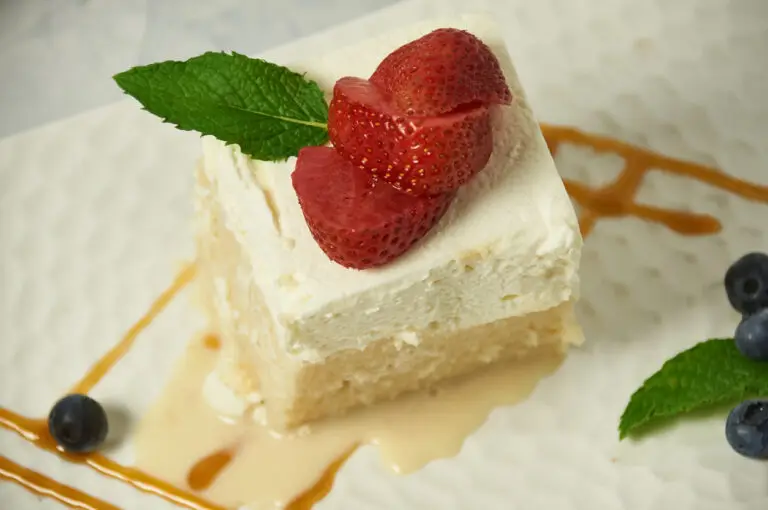
Authentic Tres Leches Cake Recipe
Sourced from a 1984 edition of the Miami Herald, this authentic tres leches cake recipe (pastel de tres leches) is a light vanilla sponge cake made with separated eggs for maximum airiness, soaked in a three-milk mixture of sweetened condensed milk, evaporated milk, and whole milk, then finished with lightly sweetened whipped cream. Rooted in a Nicaraguan baking tradition that gained momentum in the 1930s as canned dairy became widely available across Central America, this vintage recipe produces a moist, spongy cake that absorbs every drop of the milk soak without losing its structure.
- Total Time: 9 hours
- Yield: 12 Servings 1x
Ingredients
- 1 cup all-purpose flour
- 1 1/2 teaspoons baking powder
- 1/4 teaspoon salt
- 5 large eggs, separated, at room temperature
- 1 cup granulated sugar, divided (3/4 cup + 1/4 cup)
- 1/3 cup whole milk, at room temperature
- 1 teaspoon vanilla extract
- 1 can (14 oz) sweetened condensed milk
- 1 can (12 oz) evaporated milk
- 1 cup whole milk
- 2 cups heavy cream, cold
- 3 tablespoons powdered sugar
- 1 teaspoon vanilla extract
- Fresh strawberries or fresh berries
- Ground cinnamon
Instructions
Make the Vanilla Sponge Cake:
- Prep the pan: Preheat your oven to 350°F (175°C). Grease a 9×13-inch baking dish or ceramic pan and lightly flour, tapping out any excess. Set the prepared pan aside.
- Mix the dry ingredients: In a large bowl, whisk together the flour, baking powder, and salt. Set the dry ingredients aside.
- Separate the eggs: Separate your eggs into two clean mixing bowls. Make sure the bowl for your egg whites is completely clean and free of any grease or oil. Even a tiny trace of egg yolk can prevent the whites from whipping up to those beautiful, fluffy peaks.
- Beat egg yolks: Beat the egg yolks with ¾ cup of the sugar on high speed until the egg yolk mixture is thick, pale yellow, and forms a ribbon when the beaters are lifted, about 3 to 4 minutes.
- Add the milk and vanilla: Add the whole milk and vanilla extract and mix until just combined.
- Fold in the flour mixture: Pour the egg yolk mixture over the flour mixture and fold gently with a rubber spatula until no dry streaks remain. The cake batter will be thick. Stop mixing as soon as it comes together.
- Beat the egg whites: Using clean beaters, whip the egg whites on medium speed until foamy and opaque. Increase to high speed. Once the whites begin to hold shape, gradually add the remaining ¼ cup of sugar and continue beating until stiff peaks form. The whites should stand straight up without drooping when you lift the beaters.
- Fold in the egg whites: Fold one-third of the egg white mixture into the cake batter to loosen it, then fold in the remaining whites in two additions. Use slow, deliberate strokes with the rubber spatula, scraping from the bottom of the bowl up and over. Stop the moment no white streaks remain. The finished batter should look airy and slightly thick.
- Bake the cake: Pour the batter into the prepared pan and smooth the top evenly. Bake for 25 to 30 minutes, or until the surface is golden and a toothpick inserted in the center comes out clean.
- Cool the cake: Let the cake cool completely in the pan on a wire rack, at least 30 minutes.
Make the Tres Leches Soak:
- Mix the three milks: Whisk together the sweetened condensed milk, evaporated milk, and whole milk in a large bowl until fully combined.
- Poke holes in the cake: Once the cake has cooled completely, use a fork or wooden skewer to poke holes all over the top of the cake, spacing them about one inch apart. Go all the way to the bottom of the pan. Do not be timid here.
- Pour the milk soak: Slowly pour the entire milk mixture over the top of the cake in stages, allowing each pour to absorb before adding more. Cover the pan tightly with plastic wrap and refrigerate for at least 4 hours, or overnight for best results.
Make the Whipped Cream Topping:
- Make the whipped cream: When ready to serve, beat the cold heavy cream in a chilled mixing bowl on medium speed until it begins to thicken. Increase to high speed, add the powdered sugar and vanilla extract, and continue beating until soft peaks form. You want lightly sweetened whipped cream that holds its shape but still looks billowy, not stiff.
- Top and garnish the cake: Spread the whipped cream evenly over the cooled cake. Garnish with fresh strawberries or fresh berries and a dusting of ground cinnamon if desired. Serve cold.
- Prep Time: 30 Minutes
- Chill Time: Overnight
- Cook Time: 30 Minutes
- Category: Dessert
- Method: Baking
- Cuisine: Latin American
How to Make Perfect Tres Leches Cake Every Time
Room Temperature Eggs Are a MUST
Room temperature eggs whip to a significantly higher volume than cold eggs pulled straight from the refrigerator. For the egg yolks, this means a thicker, ribbon-like egg yolk mixture that holds air as it beats pale yellow and fluffy. For the egg whites, cold eggs take considerably longer to reach stiff peaks and are more likely to collapse during folding. Pull your eggs out at least 30 minutes before you start. It is a step that costs you nothing except a little forethought, and it quietly determines whether your sponge turns out airy or flat.
Beat the Egg Whites All the Way to Stiff Peaks
This is the single step where most tres leches recipes go sideways, and it deserves your full attention. Start the egg whites on medium speed until they look like a thick white mixture with no watery streaks. Then increase to high speed and add the sugar gradually as the whites continue to whip. You are looking for stiff peaks that stand straight up without drooping or curling when you lift the beaters. Soft peaks, which curl over at the tip, are not enough structure for this cake. The difference between soft peaks and stiff peaks is usually about 60 to 90 seconds at high speed, so stay with it and do not walk away to check your phone.
Poke Holes Like You Mean It
Once the cake cools, use a fork to poke holes all over the surface, spacing them about an inch apart, pressing all the way to the bottom of the pan. Many first-time tres leches bakers are too gentle at this step, which results in milk pooling on top of the cake rather than soaking through it. The holes are the delivery system for the milk mixture. A well-poked cooled cake should absorb the entire soak within a few hours. If you are second-guessing yourself about whether you have poked enough holes, poke a few more rows. You genuinely cannot overdo this step.
Give It the Overnight Soak
For best results, refrigerate the soaked cake overnight rather than the minimum four hours. The longer the cake sits, the more evenly the milk mixture distributes through every layer, including the very bottom. A four-hour cake is good. An overnight cake is the best tres leches you will make all year. Cover the pan tightly with plastic wrap to prevent the cake from absorbing any refrigerator odors, and resist the urge to check on it every few hours. It is fine. Let it rest.
Tres Leches Cake Recipe Variations, Serving Ideas, & Storage
Recipe Variations
Frequently Asked Questions
An authentic tres leches cake recipe is built on a vanilla sponge cake made with separated eggs, where the egg whites are beaten to stiff peaks and folded into the batter to create an airy, open crumb structure. That crumb structure is what allows the cake to fully absorb a three-milk soak of sweetened condensed milk, evaporated milk, and whole milk without collapsing or turning dense.
Many shortcut versions substitute a box cake mix, which produces a tighter, denser crumb that holds less milk and results in a less flavorful, less satisfying final cake.
Tres leches cake, or pastel de tres leches, originated in Nicaragua, according to food historians including NYU professor of food studies Lourdes Castro, who stated in the Wall Street Journal that the dessert belongs to Nicaragua.
The tradition of soaking cakes in liquid dates back to English colonial influence in the 1600s, and the modern three-milk version developed in the 1930s when sweetened condensed milk and evaporated milk became widely accessible across Central America.
While Mexico adopted and celebrated the recipe broadly, in part because Nestle printed it on condensed milk cans distributed throughout Latin America, the dessert's origin is Nicaraguan.
Tres leches cake became associated with Cinco de Mayo in the United States largely because of the widespread adoption of the dessert throughout Mexico, where it became a staple at celebrations ranging from baptisms to quinceañeras to birthdays.
Though pastel de tres leches originated in Nicaragua, it spread through Latin America and became so deeply embedded in Mexican food culture that it travels with that cultural identity wherever Mexican communities celebrate.
When Latin American food gained broader visibility in the U.S. through events like Cinco de Mayo, tres leches was consistently one of the most beloved desserts at the table.
If you are building a full Cinco de Mayo spread, traditional conchas make a beautiful addition to the table alongside this cake.
Tres leches cake is genuinely better when made the day before serving. Bake the vanilla sponge cake, let it cool completely, poke holes all over the surface, pour the entire milk mixture over the top, cover with plastic wrap, and refrigerate overnight.
The overnight soak allows the milk mixture to fully distribute through every layer of the cake for an evenly moist, cohesive result. Add the whipped cream topping and fresh strawberries the morning of serving or right before guests arrive so the presentation stays fresh.
The three kinds of milk in a traditional tres leches cake are sweetened condensed milk, evaporated milk, and whole milk (or sometimes heavy cream in richer variations).
Sweetened condensed milk provides thick sweetness and a slightly caramel-like quality. Evaporated milk adds body and a cooked, full-flavored depth that regular milk cannot replicate. Whole milk thins the mixture enough for it to travel all the way down through the airy cake.
Using all three different types of milk together creates a soak with perfect density and balance that no single milk achieves on its own.
Egg whites have reached stiff peaks when they stand straight up without drooping or curling when you lift the beaters from the bowl. The white mixture should look glossy and hold its shape firmly without any slipping or sagging.
If the peaks curl over at the tip, those are soft peaks, and the whites need another 60 to 90 seconds on high speed. A key sign that you have gone too far is a grainy or curdled appearance in the whites, which means they are over-beaten and will not fold cleanly into the cake batter.
Both a glass pan and a ceramic pan work well for tres leches cake, and a 9x13-inch baking dish in either material produces an even, uniform sponge. Glass conducts heat slightly faster than ceramic, so check the cake a few minutes early if using a glass pan.
The most important factor is the depth of the dish, since tres leches needs enough room for the sponge to rise and then absorb the full volume of the milk soak. Thin metal baking pans can cause uneven baking on the bottom layer, so a glass or ceramic option gives you more consistent results.
A soggy top on tres leches is almost always caused by one of two things: the cake was not completely cool when the milk soak was poured, or the cake did not have enough holes poked through it for the liquid to absorb evenly.
When milk hits a warm cake, it pools on the surface instead of soaking through the crumb. For best results, let the cake cool at room temperature for at least 30 minutes after baking, poke generous holes across the entire surface all the way to the bottom of the pan, and pour the milk mixture slowly in stages to give each pour time to absorb before you add more.
Tres leches cake can be frozen without the whipped cream topping for up to one month. After the soaked cake has been fully refrigerated and the milk mixture has absorbed, wrap the entire pan tightly in plastic wrap followed by a layer of foil.
Thaw the cake overnight in the refrigerator before serving. Make a fresh batch of lightly sweetened whipped cream after thawing and spread it over the top of the cake just before serving. The spongy texture holds up well through freezing as long as the cake is wrapped thoroughly to prevent freezer burn.
The correct oven temperature for tres leches cake is 350°F (175°C). This moderate oven temperature allows the vanilla sponge to bake through evenly without browning the top too quickly or setting the outside before the center is done.
If your oven runs hot, begin checking the cake at 22 minutes rather than 25. You are looking for a golden surface and a toothpick inserted in the center that comes out clean.
An under-baked sponge, even slightly, produces a dense crumb that cannot absorb the milk mixture properly, which undermines the entire dessert.
Pin This Authentic Tres Leches Cake Recipe For Later
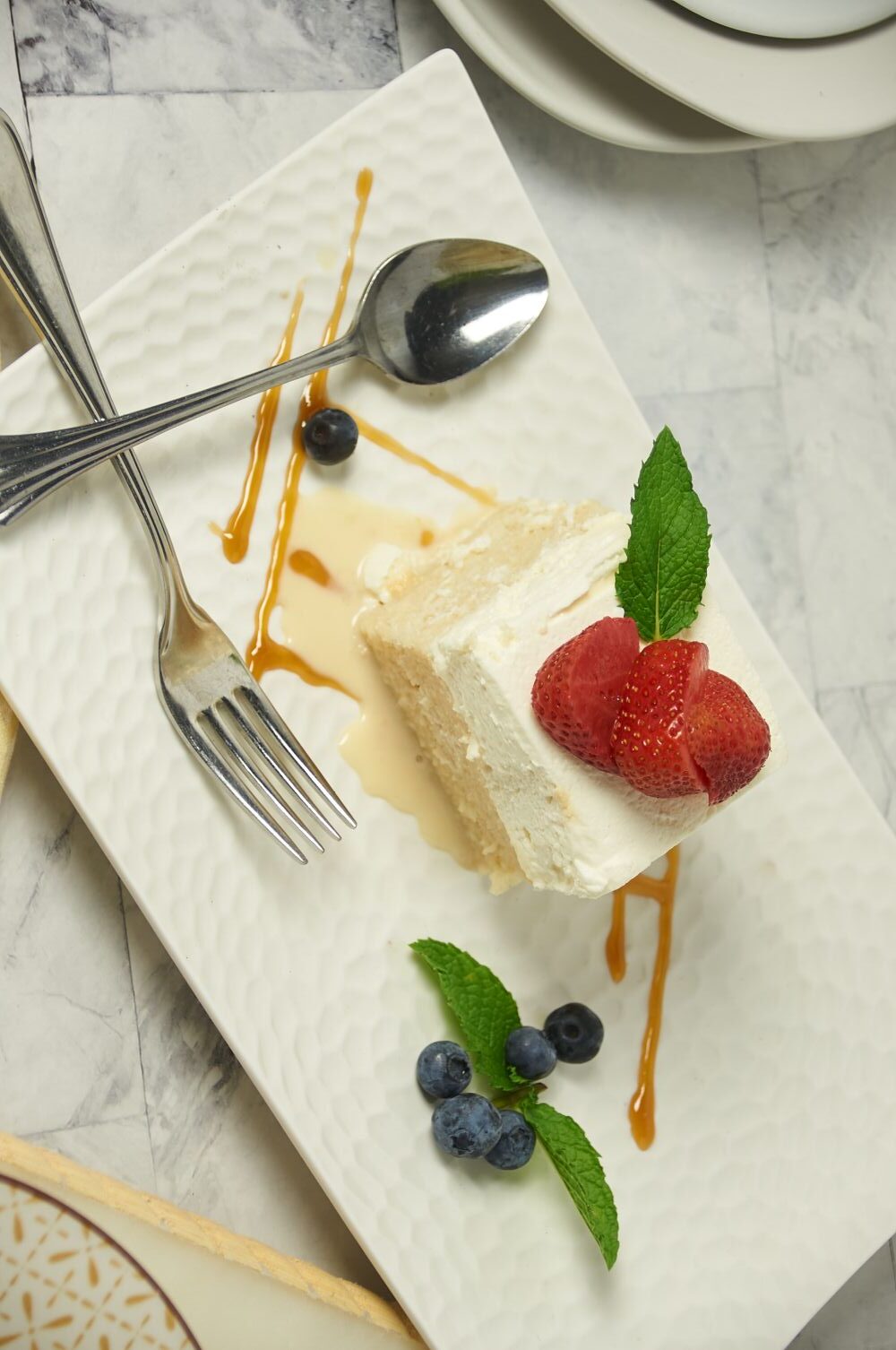
One Cake That Never Needed Updating
Forty years after it appeared in the Miami Herald, this authentic tres leches cake recipe still earns the same reaction: people go quiet on the first bite, and then someone at the table asks for the recipe before the pan is half empty. That is the power of a well-built sponge, a perfectly balanced milk soak, and a cloud of lightly sweetened whipped cream that makes the whole thing look more effortless than it was.
Take it to your Cinco de Mayo table alongside these Baja fish tacos for the full spread, and bring home the empty pans.
If you make this recipe, please leave a rating and a review below. And if you are saving it for later, pin it before you go so you can find it when Cinco de Mayo (or a Tuesday night craving) rolls around.


0 comments