

You hoped you would get a gorgeous loaf of sourdough bread out of the oven, but during the bake, the crust split open like a fault line. The bread baked up fine. It tasted decent. But it looks like something went wrong ... because something did. If you have ever asked yourself "what is a bread lame" and whether you actually need one, that split on the side of your loaf is your answer.
Dough under pressure makes its own decisions, and those decisions rarely look good on a cutting board. Fortunately, the fix is a simple tool: a bread lame (pronounced "lahm" rhyming with "mom") puts you back in charge of where and how your loaf opens up. Once you understand what it actually does, the results speak for themselves.
The Blowout Problem Every Bread Baker Faces
When bread rises in a hot oven, the gases and steam trapped inside the dough expand rapidly. That pressure has to go somewhere, and the loaf will find an exit whether you planned one or not.
Without a score on the surface of the dough, the loaf finds its own exit point, which is always the weakest spot in the crust. Bakers call this a blowout. It's really not the end of the world, but it looks amateurish, and it affects texture too.
A blowout produces a dense, uneven crumb in the area where the crust ruptured. You lose the controlled rise that creates an open, airy structure throughout the loaf.
The process of scoring the dough solves this issue by giving the expansion of the loaf a planned route. You decide where the bread opens up. The dough follows that path. The result is a loaf with even oven spring, a properly developed crumb, and a golden crust that looks intentional and even artistic.
The Drag Problem: How Kitchen Knives Destroy Good Dough
Most food blogs tell you to use "a sharp knife" for scoring (I'm sure I have in at least one of my bread recipes ::hangs head in shame::). That advice is not wrong enough to argue with, but it is not good enough to keep repeating.
A sharp kitchen knife is thick behind the edge, and that thickness creates friction the moment it contacts sticky bread dough. The blade does not part the dough's surface cleanly. It compresses it first, snags on the gluten strands, and by the time the cut is finished, you have pushed more air out of the loaf than you intended.
That is called drag, and drag is the enemy of oven spring.
A bread lame solves this with geometry. The ultra-thin metal razor blade, the same category you would find in a straight-razor barber shop setup, mounted on a long thin stick, has almost no material behind the cutting edge. It enters the dough's surface and exits without resistance. One pass. Clean cut. The gluten structure stays intact, the gases stay where they belong, and the loaf gets its full controlled rise in the oven.
There is one more thing worth knowing. Some bakers skip the lame entirely and hold a bare razor blade between their fingers. This works until it doesn't, and when it goes wrong, it goes wrong fast.
A lame gives you a comfortable handle, a firm grip, and on most models a protective leather cover that keeps the blade secured between uses. Professional bakers moved past the bare-blade workaround decades ago. You do not need to repeat that particular learning curve.
Once you score a loaf with a proper lame for the first time, you will understand immediately why kitchen knives belong in a different drawer.
Scoring Bread Dough Has a 4,000-Year Track Record
Before Instagram made sourdough scoring a competitive sport, bakers in Ancient Egypt were cutting the surface of their loaves because they noticed it produced lighter, better bread. They did not have food science to explain it. They had observation and repetition, which turns out to be a perfectly valid laboratory.
The practice moved forward into medieval Europe with a practical twist. Communal wood-fired ovens were the standard in most villages, meaning every family loaded their raw loaves into the same oven at the same time. Scoring became each family's signature design, the equivalent of writing your name on your lunch bag, except the stakes were higher because that loaf was dinner. Your slash pattern told you which bread was yours when the oven door opened.
By the time professional baking guilds standardized the craft across Europe, scoring had become a quality signal. A baguette carried specific lame blade marks. A miche had its own pattern. These were not decorative choices. They were a professional language, a way of communicating bread type, baker identity, and production standard without a single word. The scoring process meant something, and the bakers who used it understood exactly what they were saying.
Irish soda bread carried its own scoring tradition, the deep cross cut into the top was said to ward off evil and let the fairies out, but the practical reality is that it helped the dense, unleavened dough expand evenly in the oven without cracking randomly. Four thousand years of baking instinct and superstition occasionally arrive at the same answer.
The Three Types of Bread Lames
Recipe Rewind is an Amazon Associate and earns from qualifying purchases made through our affiliate links. We only recommend kitchen tools and products that coordinate with our vintage recipes and traditional cooking methods. Your purchases help us keep culinary traditions alive.
Not every bread lame is built for every job, and picking the wrong configuration does not ruin your bread, but it does make the work harder than it needs to be. Here is what each one actually does.
The Straight Blade
A straight lame 🛒 is the right starting point for most home bakers. It handles boules, round loaves, and clean decorative patterns like parallel lines, a simple cross, or a crosshatch grid without any complication. The straight blade keeps your cut vertical and consistent across flat and gently curved surfaces, which covers the majority of what a home baker scores on a regular weekend.
The Curved Blade
A curved lame 🛒 is built for baguettes and batards. The arc of the blade lets you hold a consistent 45-degree angle along the full length of the loaf without adjusting your wrist mid-stroke. That consistent angle is what produces a clean, pronounced ear from one end of the loaf to the other. The curve does part of the technique work for you, which matters when you are moving fast across 18 inches of dough in under a second.
The UFO Lame
The UFO lame 🛒 is a small, circular holder designed for intricate designs. Wheat stalks, leaf patterns, geometric shapes, the kind of scoring that looks like it belongs in a bakery window rather than a home kitchen. It trades speed for precision and is not the tool you start with. It is the tool you work toward once basic scoring feels automatic and you want to take the craft further.
Adjustable Options
Several modern lames switch between straight and curved blade 🛒 configurations with a simple adjustment. For home bakers who rotate between different bread types, this is the practical choice. One tool, both functions, no drawer full of redundant equipment.
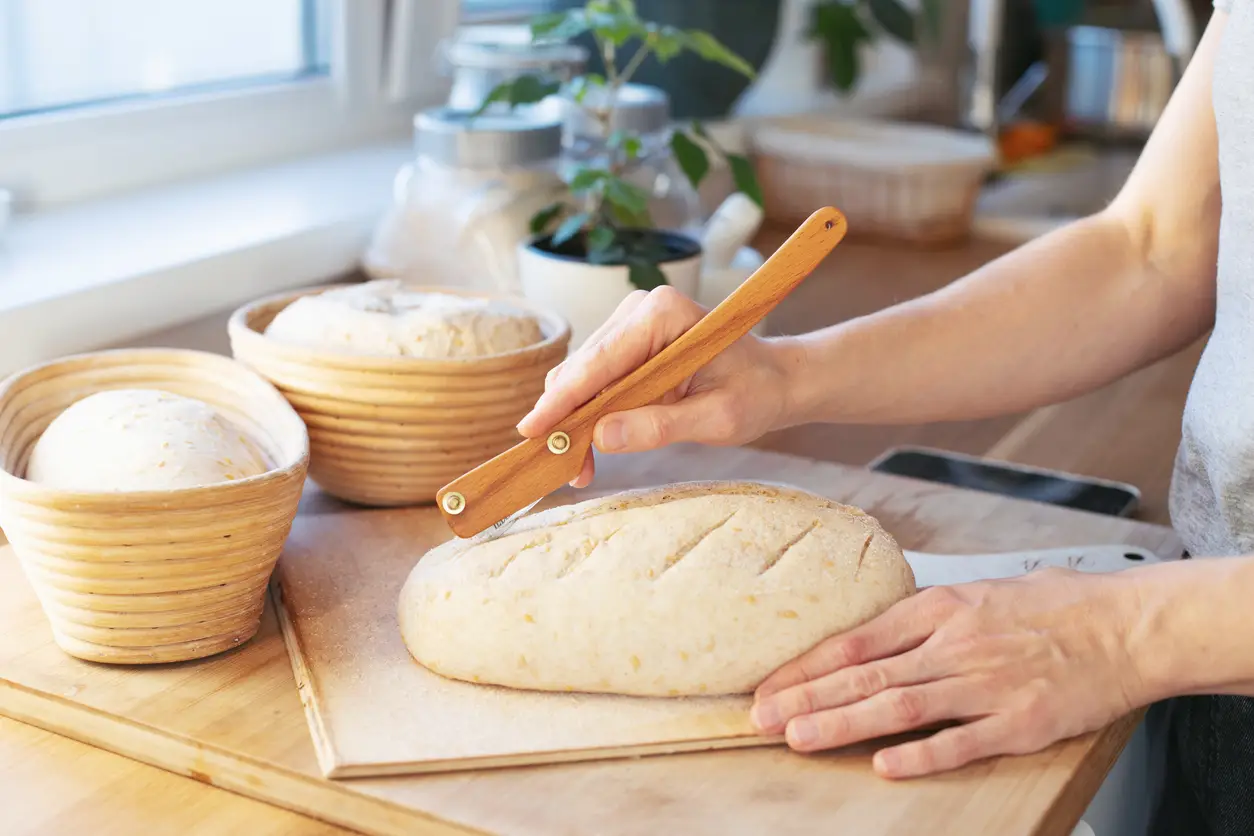
Choosing the Right Blade Setup
The lame itself is just the handle. The replaceable blade is where the cutting actually happens, and blade quality matters more than most beginning bread bakers realize.
Look for a lame with a comfortable handle that gives you a firm grip through a full scoring pass. Some are simple long thin sticks with the blade bent into a curve at one end. Others are more ergonomic with textured handles designed for high-hydration dough, where the loaf surface can be tacky and resistance builds quickly.
The blade should feel secure with no wobble. A loose blade shifts during the cut, which produces ragged, uneven scores instead of clean cuts. Some models include a protective leather cover that keeps the blade guarded during storage and between uses. This is not a luxury feature. It is a necessary feature if you keep your tools in a drawer or knife block with other kitchen equipment.
Pro Tips for the Perfect Score
These are the variables that actually separate a clean score from a torn mess.
Score Cold Dough
Scoring cold dough straight from the refrigerator is significantly easier than scoring dough at room temperature. Cold dough holds its shape under the blade and offers more resistance, which helps the lame blade make a clean cut without dragging. If you are cold-retarding your sourdough overnight, score it right out of the fridge before it goes into the oven.
Move Fast and Commit
Each scoring pass should take roughly half a second. Slow, hesitant cuts give the blade time to stick to the dough's surface and drag, which tears the gluten structure instead of slicing through it. Quick and decisive is the rule. This takes about three or four loaves to internalize. Do not second-guess the stroke mid-cut.
Match Your Depth to Your Goal
Aim for 1/4 to 1/2 inch deep for main expansion cuts. These are the scores designed to control the rise and create the ear. Shallower cuts, around 1/8 inch, work for intricate designs and decorative patterns where you want the surface of the dough to open slightly without producing a full structural split.
Work With Good Light
This sounds minor until you score the wrong side of a batard at 6 a.m. Good overhead light lets you see exactly where your blade is tracking and adjust angle mid-stroke if needed.
Blade Maintenance and Safe Storage
A lame blade is inexpensive. Replacing it regularly is not optional.
Change the blade every 15 to 20 loaves, or the moment you feel it starting to tug rather than slice. A dull blade drags through the dough instead of parting it cleanly, which causes the loaf to deflate. You will feel the difference. When the blade stops feeling effortless, swap it out.
For cleaning, never use abrasive materials. Wipe the blade with a dry cloth or slightly damp cloth after each use to remove any dough residue. Dough left on the blade can harden and cause rust spots that compromise future cuts.
Always store your lame in its protective cover or sheath. This protects the blade edge from contact with other tools and protects your fingers from an unexpected encounter during the next time you reach into a drawer. Most lames come with a protective cover. Use it every single time.
Scoring as a Skill, Not Just a Step
If you have been making bread bakers' mistakes by skipping the score or using kitchen knives, you now have the straight picture. A bread lame is not decorative equipment. It is the tool that controls how your loaf behaves in the oven, how your crust develops, and whether the baking process produces delicious bread with a proper crumb or an unpredictable blowout.
Start simple. A single straight slash down the center of a boule, or a classic cross, gives you all the benefits of controlled expansion without requiring artistic skill. Once that feels automatic, add a second parallel slash. Then try the 45-degree angle and watch the ear develop. From there, basic scoring turns into wheat stalks, leaf patterns, and more intricate designs as your confidence builds.
The reward is real. A well-scored loaf bakes with better oven spring, produces a crispier crust with more developed flavor, and comes out of the oven looking like you knew exactly what you were doing, because you did.
High-quality bread built on solid technique is repeatable. Learn the score, and every loaf after this one will be better than the last.
Frequently Asked Questions About Using a Bread Lame
A bread lame is a specialized scoring tool: a razor-sharp blade mounted on a long ergonomic handle, designed specifically to cut bread dough cleanly before it goes into the oven.
Home bakers need one because a standard kitchen knife, no matter how sharp, is too thick behind the edge to part sticky dough without dragging and deflating the structure you spent hours building.
A lame's ultra-thin blade glides through the dough's surface in one clean pass, putting you in control of exactly where and how your loaf expands. That control is the difference between a loaf that looks intentional and one that looks like it had an accident.
A straight blade lame works best on boules and round loaves where the blade travels across a relatively flat surface.
A curved blade lame is built for baguettes and batards, where the arc of the blade maintains a consistent 45-degree angle along the full length of the loaf without requiring you to adjust your wrist mid-stroke. That consistent angle is what produces a clean, pronounced ear from end to end.
Many experienced bread bakers keep both on hand, or invest in an adjustable lame that handles both jobs. Start with a straight blade, add the curved blade once you are scoring regularly.
For main expansion cuts, the scores designed to control where your bread rises and create the ear, aim for 1/4 to 1/2 inch deep. These are your structural cuts and they need enough depth to direct the expansion of the dough properly.
For decorative patterns and intricate designs layered on top of the main score, shallower cuts around 1/8 inch are enough to open the surface without splitting the loaf.
Score your main cuts too shallow and the dough will find its own exit point, which is never where you wanted it.
Cold dough fresh from the refrigerator is firmer, holds its shape under the blade, and offers just enough resistance for a clean cut. Dough that has warmed to room temperature softens and becomes tacky, which causes the blade to drag and stick instead of slicing through cleanly.
This is why most experienced bread bakers score straight from the fridge without letting the dough sit out first. Cold dough is not a workaround. It is standard practice, and once you try it you will not go back.
Change your blade every 15 to 20 loaves, or the moment you feel it starting to pull rather than slice. A dull blade compresses the dough before it cuts through it, which deflates your loaf and produces a ragged, torn score instead of a clean one.
Replacement blades cost almost nothing. There is no good reason to push a blade past its useful life when a fresh one takes ten seconds to swap in and immediately produces better results. Dull tools are a false economy in any kitchen.
For a basic expansion cut, a near-vertical angle around 70 to 80 degrees gets the job done. The loaf will open and rise with good oven spring.
To produce an ear, drop the blade to 30 to 45 degrees relative to the surface of the dough. That lower angle creates a flap instead of a slit, and as the loaf expands in the oven, that flap lifts and curls back into the crispy raised ridge that tells everyone in the room you knew exactly what you were doing. Angle is not a minor detail. It is the whole game.
A bread lame is not just compatible with high-hydration dough, it is the only tool that handles it reliably.
Wet, sticky dough grabs onto a thick kitchen knife blade immediately, compressing and deflating the loaf before the cut is even finished. A lame's ultra-thin razor blade parts the surface with minimal contact and zero drag.
Score high-hydration sourdough bread straight from the refrigerator for the cleanest results. Cold plus sharp equals a score that opens exactly the way you planned it.
The ear is the raised, crispy flap of crust that forms along the top of a loaf when the dough is scored at an angle and expands during baking. When the blade enters the dough at 30 to 45 degrees, it creates a thin flap that lifts and curls back as the bread rises in the oven, forming a dramatic ridge along the score line.
The ear is considered the clearest visual indicator of proper scoring technique and strong oven spring. It also happens to be the crispiest, most caramelized section of the entire crust, which is reason enough to learn how to produce one consistently.
After each use, wipe the blade with a dry cloth or a slightly damp cloth to remove any dough residue before it hardens. Skip the abrasive scrubbers and keep it out of the dishwasher entirely, both will dull the edge and invite rust.
Store the lame in its protective leather cover or sheath every single time, not occasionally, every time. A bare blade rattling around in a drawer dulls faster, damages other tools, and will eventually find your fingers. Thirty seconds of proper storage after each use keeps the blade sharp and keeps you safe.
Sourdough bread, baguettes, batards, and lean doughs with a well-developed gluten structure get the most out of a bread lame. These loaves have the tension and structure needed to hold a score cleanly and produce a dramatic ear.
Enriched doughs like brioche or soft sandwich loaves are more forgiving and do not strictly require a lame, though scoring still helps manage expansion. The general rule is straightforward: the tighter and leaner the dough, the more a lame earns its place in the process.
Your Next Loaf Is Going to Look Different
Scoring is where the baking process stops being purely technical and starts being yours. The patterns you put on the surface of the dough are a signature design, a mark that says you understood not just the recipe but the craft behind it.
Start with a single slash. Get that one right, then try the cross, then the 45-degree angle that produces the ear. Within a few loaves, basic scoring will feel automatic, and you will start looking at wheat stalks and leaf patterns the same way you look at a recipe you want to try. Achievable. Worth the practice.
The bread bakers who consistently produce high-quality bread are not working with secret ingredients. They are working with the right tools, used correctly, every time. A bread lame is one of those tools. It is a new item for a lot of home kitchens, but it is one of those purchases that makes you wonder how you ever managed without it.
If you try scoring your next loaf with a lame, leave a rating and a comment below. I want to hear how the ear turned out.

0 comments