

If you grew up in a German or Polish community, where families were making their own sauerkraut from garden cabbage, you already know that this sauerkraut casserole with Polish sausage and apples isn't a trendy recipe. It's a Tuesday night meal. The tangy fermented kraut, sweet quartered apples, and browned sausage bake down together in one covered dish into something that tastes like an entire community's kitchen traditions showed up for dinner.
Fair warning before you keep reading: if the smell of sauerkraut makes you leave a room, this recipe will not change your position on that. The flavor is bold. But if you're among those who genuinely love sauerkraut, or grew up next door to someone who kept a fermentation crock on the back porch, you're going to recognize every single thing happening in this dish.
What goes best with bratwurst? The answer is always sauerkraut. In neighborhoods with Central European roots, sauerkraut was never inauthentic. It was cheap and it was homemade from cabbage that came out of the garden. This recipe from the early 2000s carries all of that forward: the caraway seeds, the brown sugar taming the tang without eliminating it, the apples softening into the brine.
Back in the Farmhouse Kitchen
In the communities where this recipe lived, sauerkraut wasn't something you bought in a can at the supermarket out of obligation. Families in German and Polish neighborhoods across the Great Lakes and the Midwest had been fermenting cabbage at home since their great-grandparents arrived in the late 1800s. A ceramic crock, a wooden tamper, garden cabbage, and salt. That was the whole operation. The result was sharper and more alive than anything shelf-stable, and it was everywhere: piled on bratwurst at backyard grills, served with pierogies at church suppers, and baked into casseroles like this one.
By the early 2000s, that tradition was still humming along in those same communities, even as the rest of American food culture was chasing sun-dried tomatoes and fusion everything. The casserole dish in this recipe was showing up at neighborhood gatherings without any fanfare, served to people who didn't think of it as "ethnic food"; it was just how you cooked in winter when the pantry was stocked and you had an hour.
Here's the thing: the reason this recipe survived isn't nostalgia. It's because the flavor combination: fermented cabbage, rendered pork fat, apple sweetness, caraway warmth ... it is genuinely balanced in a way that feels intuitive once you've eaten it. It doesn't need updating. It just needs to be made!
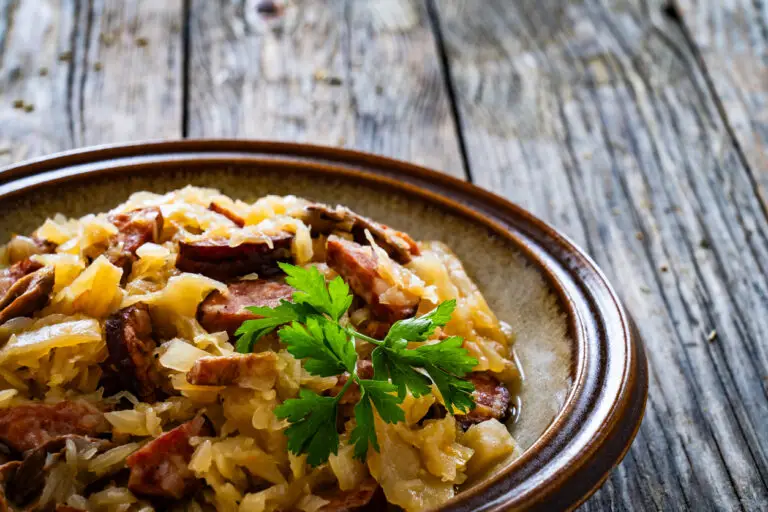
Old Fashioned Sauerkraut Casserole Recipe
This vintage sauerkraut casserole with Italian sausage and apples is a country dish rooted in the German and Polish home cooking traditions of Midwestern communities. Polish sausage is browned with onion in a skillet, combined with undrained sauerkraut, quartered apples, brown sugar, and caraway seeds, then baked covered at 350°F for one hour. The result is tangy, sweet, and savory with a braised richness that develops entirely in the oven. Leftovers taste better the next day. This is cold-weather cooking at its most straightforward.
- Total Time: 1 Hour 30 Minutes
- Yield: 8 Servings 1x
Ingredients
- 1 pound Polish sausage, cut into 1-inch slices
- 1 large onion, chopped
- 2 medium apples, peeled and quartered
- 1 can (27 ounces) sauerkraut, undrained
- 1 cup water
- 1/2 cup packed brown sugar
- 2 teaspoons caraway seeds
- Fresh parsley for garnish (optional)
Instructions
- Preheat oven to 350°F.
- In a large skillet over medium heat, cook the sausage slices and chopped onion together, stirring occasionally, until the sausage is browned on at least one side and the onion is softened and translucent. Drain excess fat from the skillet.
- Transfer the sausage and onion to a large bowl. Add the quartered apples, undrained sauerkraut, water, brown sugar, and caraway seeds. Stir to combine.
- Transfer the entire mixture to a 2.5-quart baking dish. Cover tightly with a lid or heavy-duty aluminum foil, sealing the edges completely.
- Bake at 350°F for 1 hour, until the sausage is fully cooked through, the apples have softened, and the braising liquid is bubbling at the edges.
- Garnish with fresh parsley if desired. Serve hot with the braising liquid spooned over each portion.
- Prep Time: 15 Minutes
- Cook Time: 1 Hour 15 Minutes
- Category: Dinner, Lunch, Side Dish
- Method: Baking
- Cuisine: German, Polish
Why This Old Fashioned Sauerkraut Casserole Recipe Works
Recipe Variations, Serving Ideas, & Storage
Recipe Variations
Frequently Asked Questions
Yes, and most home cooks do. Do not drain it; the recipe uses undrained sauerkraut specifically because the fermented brine carries the flavor. A 27-ounce can is the exact size listed in the original recipe.
A 2.5-quart covered baking dish is specified in the original recipe and for good reason: the proportion of liquid to solids is calibrated for that size. If you use a larger dish, the liquid spreads too thin. If you can't find a covered dish, seal the top tightly with heavy-duty foil. A 5-quart enameled Dutch oven also works exceptionally well and lets you complete the skillet step and the bake in a single pot.
A Dutch oven is one of the best vessels for this recipe. The heavy base distributes heat evenly from the bottom, which prevents the bottom layer of kraut from drying against the dish. Brown the sausage and onion directly in the Dutch oven, add everything else, cover, and bake at 350°F for one hour. Zero cleanup advantage over the original method, but notably better heat distribution.
It reheats well and gets better. The overnight rest redistributes the braising liquid into the sausage and apple pieces, making the second-day version more cohesive and flavorful than the same-day serving. Reheat covered to avoid drying out the top layer.
Yes. Sliced bell pepper or a quartered fennel bulb both work well added during the skillet step with the onion. Fennel amplifies the caraway flavor significantly — if you enjoy that combination, it is worth trying. Root vegetables like parsnip or turnip hold up through the full bake time and absorb the braising liquid in a way that makes them taste completely different from how they taste roasted on their own.
You can, but the dish becomes something fundamentally different. Sauerkraut's fermented tang is the flavor anchor of this casserole. Fresh cabbage is milder and sweeter, and while that makes a perfectly fine dish, it is not this dish. If you want to try fresh cabbage, slice it thin and add 2 tablespoons of apple cider vinegar to replace some of the missing acidity.
Baked sauerkraut mellows significantly compared to kraut eaten cold from the jar. The covered, hour-long bake softens the sharpest acidic edges while preserving the savory, fermented backbone. The brown sugar and apples add sweetness, and the caraway rounds the whole profile with a slightly herbal, cooling quality. People who are skeptical about sauerkraut have, more than once, gone back for a second bowl of this casserole without fully understanding what changed their mind.
The ingredient list is naturally gluten-free: Italian sausage links, onion, apples, sauerkraut, water, brown sugar, and caraway seeds. Check the label on your specific sausage brand, as some contain fillers with wheat. Serve over rice instead of egg noodles to keep the entire meal gluten-free.
Yes. Use a 9x13-inch baking dish, increase all quantities by 1.5 to 2 times, and keep the bake time at 350°F for one hour. A larger, fuller dish may need an additional 10 to 15 minutes. Confirm the sausage is cooked through and the apples have softened before pulling it from the oven.
Undrained sauerkraut plus one cup of water plus the moisture released by the apples as they cook produces a generous amount of braising liquid — this is by design. That liquid is the sauce. If you prefer a less soupy result, reduce the added water from 1 cup to 1/2 cup. Otherwise, spoon the liquid generously over each serving, or serve over egg noodles to absorb it.
Pin This Old Fashioned Sauerkraut Casserole Recipe For Later

Was Sauerkraut on Your Table Growing Up?
Drop a comment below, especially if you grew up in a community where sauerkraut was a staple rather than a specialty. And if you tried this recipe and have a variation you loved, I want to hear about it. If this dish earned a spot at your table, a quick review below helps other readers find it, which is the whole point of keeping these recipes alive.
0 comments