

Mag Aonghus traditional Irish beer bread leans into real pub character: chewy crumb, deep malt, and a slow, yeasted rise built on Guinness and a mix of sturdy flours instead of shortcut quick-bread batter.
My recipe modernizes a 1941 formula from Dublin's Slattery's Bar by adding active yeast to compensate for today's pasteurized beer, which no longer contains the live cultures that originally helped the dough rise. You get real bread with structure and chew, not the dense biscuit texture of no-yeast versions.
This was the situation with Dublin in 1941: Ireland declared neutrality during World War II, which they diplomatically called "The Emergency" because apparently calling it a world war felt too committal. Rationing still happened, supplies got scarce, and pubs like Slattery's on Capel Street kept serving working men who needed more than just a pint to get through the day.
1941 Dublin: When Pub Bread Actually Mattered
Walk into Slattery's Bar today, and you're standing in a place that's been pouring drinks since 1821. They got their early house license in 1892 specifically to serve market workers who showed up before dawn needing fortification before hauling produce all day. By 1941, it was a neighborhood anchor where regulars knew everyone's name and bread came standard with your stew because that's how you stretched a meal.
Pub kitchens made beer bread because it made practical sense, not because some (ahem) food blogger decided it was "rustic" and "artisanal." Breweries ran at full capacity even during rationing because beer qualified as a food staple. Turns out when times get tough, people still want their pints. Who knew?
Publicans had reliable access to draft beer and spent grain from brewing, and the unpasteurized draft carried enough wild yeast to leaven bread dough without requiring separate yeast purchases that weren't always available anyway.
The bread baked in these pub kitchens used what was already sitting there, required minimal skill to execute, and produced something sturdy enough to soak up every drop of gravy without disintegrating into mush. Irish cooking has always favored dense, hearty breads with substantial crust because delicate pastries don't hold up well in a climate where it rains 225 days a year. This was fuel, not fine dining.
In an era before commercial yeast was a kitchen standard, Irish bakers mastered two distinct paths to the daily loaf. While this Mag Aonghus loaf relies on a slow, patient rise to develop its complex malty flavor, Irish Soda Bread with Wheat Germ offers a faster alternative for busy days. Together, they represent the full spectrum of the Irish hearth: one born of patience, the other of necessity.
What Makes This Irish Beer Bread Work
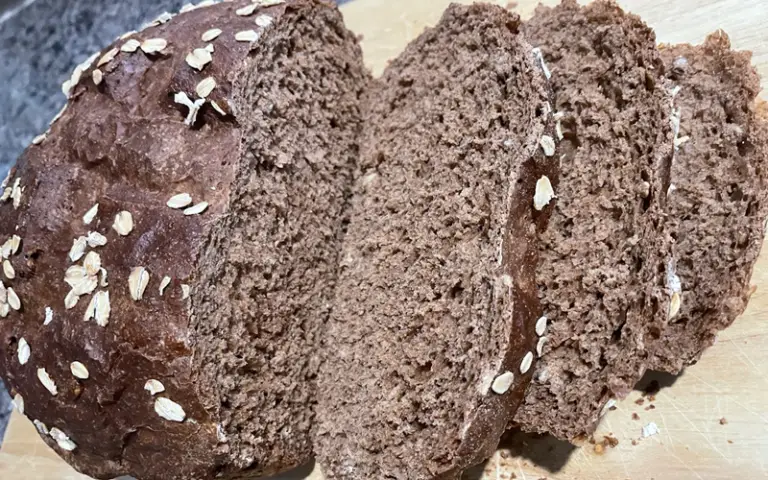
Traditional Irish Beer Bread Recipe
This authentic Irish beer bread uses Guinness stout, active yeast, and a blend of three flours to create pub-style bread with deep malty flavor and substantial texture. Unlike quick beer breads made with only baking powder, this recipe includes a double rise that develops complex flavors and creates a chewy, structured crumb. Inspired by a 1941 recipe from Dublin’s Slattery’s Bar and modernized to account for pasteurized beer.
- Total Time: 4 hours 10 minutes
- Yield: 1 loaf, 12 slices 1x
Ingredients
- 1 teaspoon active dry yeast
- 1 teaspoon white sugar
- 1 1/2 cups warm water (105-110°F)
- 2 cups all-purpose flour
- 1 cup wheat flour
- 1/8 cup rye flour
- 1/2 cup rolled oats (plus more for topping)
- 1 teaspoon kosher salt
- 1 tablespoon cocoa and espresso powder blend
- 1 teaspoon baking soda
- 1 tablespoon dark molasses
- 9-9.5 ounces Guinness Extra Stout or Draught (about 3/4 of a standard bottle)
- Butter or oil for greasing pan
- 1 egg, beaten (optional, for egg wash)
Instructions
- Proof the yeast: In a glass, combine active dry yeast, sugar, and warm water. Let stand for 5-10 minutes until foamy and bubbling. If mixture doesn’t foam, yeast is dead; start over with fresh yeast.
- Mix dry ingredients: In a large bowl, whisk together all-purpose flour, wheat flour, rye flour, rolled oats, kosher salt, cocoa-espresso powder, and baking soda until thoroughly combined.
- Combine wet and dry: Add molasses and proofed yeast mixture to dry ingredients. Transfer to stand mixer fitted with dough hook. With mixer running on medium speed, gradually add Guinness beer. Mix for 5 minutes until dough forms a smooth ball and pulls cleanly away from sides of bowl.
- First rise: Remove dough from mixer and form into a ball. Cover bowl tightly with aluminum foil. Place in a warm spot (75-80°F) for 1½ hours until doubled in size.
- Shape and prepare pan: Grease a cast iron loaf pan or standard 9×5-inch loaf pan with butter or oil. Lightly knead dough on floured surface to remove air bubbles. Shape into loaf and place in prepared pan. Using a sharp knife, score an X across the top about ¼-inch deep. Brush with beaten egg and sprinkle with additional oats, or dust with rye flour for a rustic finish.
- Second rise: Preheat oven to 120°F (or lowest setting). Place shaped loaf in pan in oven along with a heatproof bowl filled with boiling water. Turn off oven. Let rise for 1½ hours until dough domes above pan rim.
- Bake: Remove bowl of water from oven. Increase oven temperature to 350°F and preheat. Once oven reaches temperature, bake bread for 45-55 minutes until deep golden brown and internal temperature reaches 190-200°F. If top browns too quickly, loosely tent with foil during last 10 minutes.
- Cool: Let bread cool in pan for 10 minutes, then transfer to wire rack to cool completely before slicing.
How to Make Perfect Mag Aonghus Beer Bread
Recipe Variations, Serving Ideas, and Storage
Recipe Variations
Frequently Asked Questions
Yes, but you'll get quick bread texture similar to a biscuit rather than true bread structure. Most no-yeast beer bread recipes rely solely on baking powder or baking soda for leavening, which creates a denser, more crumbly result. This recipe uses yeast specifically to develop flavor and create the characteristic chewy texture of traditional pub bread.
Guinness Extra Stout or Guinness Draught both work well in this recipe. The roasted malt character and slight bitterness complement the other ingredients without overwhelming them. You can substitute any Irish stout or dark ale, but avoid IPAs (too hoppy and bitter) or light lagers (not enough flavor).
Each flour contributes different properties. All-purpose provides structure, wheat flour adds sweetness and nutrition, and rye flour delivers the earthy flavor and crust color associated with traditional Irish bread. Using only all-purpose flour would make bland white bread. The combination creates complexity.
Yes, instant yeast can be substituted 1:1 for active dry yeast. You can skip the proofing step and mix it directly with the dry ingredients, though I still recommend proofing to verify your yeast is alive before committing to the full recipe.
After the first rise, the dough should roughly double in size and feel puffy when gently pressed. After the second rise in the loaf pan, it should dome above the rim of the pan. Press gently with your fingertip: if the indentation springs back slowly, it's ready to bake. If it springs back immediately, give it more time. If it doesn't spring back at all, you've over-proofed it.
You can mix this dough by hand using a wooden spoon and then knead it on a floured surface for 8-10 minutes. The dough should become smooth and elastic. Your arms will get a workout, but it's entirely doable without a mixer.
Yes, and you'll get a rounder boule shape with a crustier exterior. Preheat the Dutch oven at 450°F for 30 minutes, carefully place the shaped dough inside, score the top, cover with the lid, and bake for 30 minutes. Remove the lid and continue baking for 15-20 minutes until deep golden brown.
Over-rising is usually the culprit. If the dough rises too long or in an environment that's too warm (above 80°F), the yeast becomes overactive and produces strong yeasty flavors. Stick to the 90-minute rise times in a moderately warm spot, not a hot one.
This bread stays moist for 4-5 days at room temperature due to the oats and molasses, which retain moisture. Most homemade breads start drying out after 2 days, so this recipe has unusually good keeping qualities.
You can fold in 1 cup of shredded sharp cheddar or Irish cheddar after the first rise. The cheese adds richness and creates a more savory loaf that's excellent with soup. Add it just before shaping the dough for the loaf pan.
Pin This Traditional Irish Beer Bread Recipe For Later

Bake This 1941 Pub Loaf in Your Own Kitchen
A loaf that outlasted wartime rationing and 85 years of kitchen trends did it by being genuinely good, not trendy. The malt depth from the Guinness, the chew from the three-flour blend, and the slow yeasted rise are decisions made by pub cooks who couldn't afford failures - and those decisions still hold up at 350°F.
If you grew up eating bread like this, or you've got your own version of the story, drop it in the comments. If you make this Mag Aonghus traditional Irish beer bread, please leave a rating and review!
0 comments